Platform
This page summarizes my stances on the issues. Some parts of the platform have a linked page with more information about the fine points of my position and the rationale for it.
- Electoral Reform
- Reducing Cost of Living
- Privatization of Regulation: Insurance, Not Compliance
- Federal Bureaucracies to Cut or Eliminate
- Stop the Wars; Cut the Military-Industrial Complex
- Eliminate Cost-Ineffective Medicare Spending
- Restore Freedom of Association
- Immigration: Open to Workers, Closed to Parasites
- End the War on Drugs
- Reform Taxation: Reward Productivity; Tax Rent-Seeking and External Costs
- Right to Bear Arms
- Accountability for the President
- Artificial Intelligence
- Permanent Standard Time, Not A Permanent Lie
Electoral Reform
The most critical problems with our electoral system are gerrymandering1 and the spoiler problem. Unlike campaign finance or balloting procedures, those directly thwart the will of the people as expressed through the actual votes cast, and thus impede necessary action on every other issue. The solutions are simple:
For Senate elections, ranked choice voting, which mostly prevents spoilers from altering outcomes, and allows options outside the two-party system to gain traction without being wasted votes.
For House elections, proportional representation on the Swiss model: each state’s House seats are filled by a party’s list in proportion to vote share (with independent candidacies allowed), with no winner-take-all districts. If, for example, the Republicans got 50% of the House vote in a state with eight seats, Republican candidates would fill exactly four seats, neither more nor less. Party lists can be determined in primaries, or by a party organization according to its rules. This allows small parties and independents with dispersed support to win representation in accordance with voter preferences, eliminating the duopoly. It would force legislation to reflect consensus among a broad range of ideas in the Capitol, representative of the sweep of Americans’ views, instead of the status quo of one specific vision using slim pluralities in a slim majority of districts to roll over all opposition and produce wild swings in policy. The Senate filibuster is a kludge for this; my proposal is a real fix. Recent polling shows majority support for this system once people understand what it is.
This would work best if tied to expanding the House. That the House has 435 Representatives was set by statute more than a century ago, and has not been adjusted to population increase. More Representatives would allow more personal attention from each Representative to their constituents, and improve proportionality under the proposed PR system for almost all states.
Reducing Cost of Living
In the last year, President Trump’s capricious tariffs, and his unconstitutional and unnecessary war on Iran, have caused major economic disruptions and hence higher prices. Ending these is low-hanging fruit for lowering the costs of consumer goods for ordinary Americans, including fuel. These tariffs have hurt farmers in the 15th District, raising the prices of essential farm equipment and supplies.
However, at the scale of decades, the crucial insight is that we do not have a rise in “cost of living”; we have a rise in the cost of housing. Everything necessary for physical survival2 has become less expensive relative to prevailing entry-level wages since 1980, with the single exception of housing. Housing costs are eating up the prosperity gains; wealth generated by entrepreneurs and workers gets funneled to landlords and longtime landowners who have done nothing to create it. This caused more than half of the last two decades’ decline in America’s fertility rate. My only objection to the YIMBY movement is that it doesn’t go far enough. Ohioans support such pro-housing policy.
Population has grown, but the supply of land around major cities and other desirable locations is fixed. Because of the favorable tax treatment given to profits from home appreciation, homeowners currently have a strong incentive to use state power to increase artificially the price of their homes by blocking higher-density construction through local governments and thus maintain scarcity. Those deprived of the opportunity to move in don’t get a vote. By changing our tax system to incide more heavily on unearned profits from land appreciation, while cutting both capital gains tax which distorts capital allocation (and thus raises prices generally) and income tax which punishes self-improvement and work, we can free up homes that are being used inefficiently, and disincentivize blocking types of very inexpensive high-density housing which used to be common in cities like Columbus.
Any federal funding should be conditioned on eliminating legal barriers to high-density housing construction and use where demand for it exists, to the full extent constitutionally permissible.3 Subsidies and rent controls proposed by some left-wing candidates do not reduce the costs; they only shift them. This is not a “war on suburbs”: if you want your children to be able to afford a suburban or rural single-family home, this is the best possible policy. Luxury apartment residents in Columbus are people not outbidding them for houses west and south of the city, and boarding house residents are people not camping on the sidewalk outside. Likewise, high-density living options make cars less necessary, which gives young adults the option to avoid a major expense just as they are beginning their careers.
Similar market-liberating reforms to child care, health care, and education, major contributors to rising cost of living as applicable to most younger households, can lower those costs as well.
Most of the high cost of child care stems from excessive regulation (in particular, requiring excessive numbers of adults per child) and problems with immigration policy (see below). To adapt Ron Swanson, starting a child care should be as easy as saying “I’m a childcare”. These regulations are a major cause of sub-replacement fertility (and associated problems with selection effects). However, this is largely a problem of state regulations, with little room for federal intervention within our constitutional system. I oppose federal childcare subsidies on the basis that, just as with housing policy, this lessens pressure on states to fix their laws. Further, childcare subsidies distort the market: if childcare costs more to a parent than their earnings less other costs arising from working (such as commuting, not being present for one’s own child, the necessity to trade money for time more in food preparation, and so forth), it is not rational for the parent to work outside the home. We should not allow the McNamara fallacy to drive caregiving spouses out of existence simply because their valuable work is not counted in GDP.
With modern technology, it is not necessary to gather students in middle and high school into physical buildings, give them in-person instruction from salaried teachers, and return them at the end of the day, at great expense in tax dollars and wasted time. The first attempts at mass fully remote learning in 2020 were doomed to fail because they were implemented by the people with the greatest vested interests in the status quo; were intended to be temporary; and were simply “in-person school done remotely”, yielding the worst of both worlds, rather than being structured to take advantage of the format’s strengths. Modern online learning platforms can adapt to how each student learns and thinks, adjusting content speed and presentation method in real time, and checking comprehension as they go. Those who excel in a subject can be taught more advanced material; those who are weaker in it will be given more practice until basic proficiency is achieved. Periodic in-person proctored testing, staggered around the year by child birth date to minimize space needs, could act as a check for cheating, algorithmic errors, and other problems; poor performance would trigger intervention from specialized staff (far fewer than are needed now) to address each particular child’s issue, in consultation with parents. A version of this has been attempted and found to succeed with a range of student populations (note that the very high tuition charged funded very expensive extended field trips and related activities, which are not essential to the core academic model). Parents who want their children to participate in “extracurricular activities” can and should pay for it themselves. This would cost far less, allowing huge property tax relief.
A major barrier to widespread adoption of these models is federal education mandates and subsidies conditioned on the pre-Internet approach to schooling. With the Department of Education eliminated, the remaining federal role in education would be to provide assistance with the transition to fully digital education.
The skyrocketing cost of higher education results from the federal subsidized student loan program, and a credentials arms race which makes their product mandatory to obtain most well-paying jobs. This is what allows the continual bureaucratic bloat, transformation of college campuses into luxury resorts, and sports which are mostly money pits. The credentialism can be addressed through removing legal barriers to the use of aptitude and skills tests for potential employees (as discussed below). The student loan program requires significant reform (or abolition) to incentivize cost control.
High health care costs are due to fee-for-service payment which incentivizes more tests and procedures (often at taxpayer expense), not better patient outcomes; overpayment of specialists; lack of price transparency; unnecessary regulations and compliance costs; unjustified barriers to entry for provision of medical services; and the tax exemptions of health benefits which distort the market and cause overuse of services. Solutions include expanding use of remote-medicine technologies (as with education), price transparency and incentives for price comparison, value-based payment, slashing regulations, redesigning the funding model, repealing much of HIPAA, and restructuring medical training (most countries do not require a separate four-year bachelor’s degree before entering medical school). Another obvious way to lower costs is to allow health insurers to adjust prices on the basis of lifestyle choices (but not pre-existing conditions unaffected by behavior). Today, people who engage in activities likely to result in injury effectively have their costs of doing so subsidized by those with lower-risk lifestyles, through equal insurance premiums. By fully opening the door to higher premiums for obese people, players of violent sports, and users of high-risk forms of transportation, everyone else’s premiums can be lowered.
It should be legal to sell one of one’s kidneys for transplant purposes. The current prohibition of this exceeds the bounds of interstate commerce when buyer, seller, and surgical facility are all in one state. More practically, it prevents consensual, mutually beneficial transactions; thousands of people in the United States die every year due to the shortage. This is a pure deadweight loss justified only by hypothetical arguments which violate economic logic about nebulous harms.
Subsidies for ethanol corn degrade the soil, raise food prices as food production is pushed onto lower-yield land, and mostly benefit big agribusiness corporations. Instead, we should invest in helping farmers adopt methods which taint our watersheds and wild places less, and growing healthy fruits, vegetables, and animal feed for local use instead of monoculture maize. We should also eliminate regulations which complicate direct sale of agricultural products to local consumers. This will lower the price of food both directly and by reducing freight costs while improving integration of farmers (and ranchers) with their communities.
Privatization of Regulation: Insurance, Not Compliance
A core justification for regulation is that absolute application of the non-aggression principle fails because entities can be judgment-proof. This breaks the market incentive system by imposing an effective maximum on the costs which anything can incur; there is no way within pure libertarian rules to prevent someone from doing something who does not have anywhere near the financial resources to pay for its worst-case consequences (whether a nuclear explosion, airliner crash, or even just a fatal car accident). A rational actor may accept a 90% chance at $10 million in profits against a 10% chance of a $1 billion catastrophe that results in his ruin or even death, because the cost to him is only at most what the rest of his life was worth to him, not $1 billion; but this has a net expected value to society of negative $91 million. Worse, in competitive markets, it can then become obligatory to take such risks or be out-competed.
The solution is suggested by our approach to liability for car accidents: states don’t prohibit driving (despite it being more dangerous than almost all workplaces); they just require liability insurance. The same approach can be taken to preventing catastrophes.
Instead of a federal agency mandating standards for nuclear power plants, airliner safety, hazardous waste storage, or even food processing, the government would simply require that any entity operating something which can fail catastrophically have sufficient assets and/or insurance coverage to pay all claims in the event of a worst-case catastrophe (from an insurance company with sufficient capital). If it is impossible to obtain insurance coverage at a price which makes a risky project or activity possible, it cannot happen; the market has determined that it is not worth it to society. Regulatory functions are then effectively outsourced to insurance companies which, unlike government bureaucrats, have a strong economic incentive to get the cost-benefit analysis right and no political interference with how they do so. For example, in this regime, there would be no law specifically prohibiting building a nuclear reactor with no containment vessel in downtown Columbus, but no sufficiently capitalized insurer would offer coverage for liability from an accident at a price low for the project to be profitable, and so it would not happen. However, if the builder had developed a new technology which eliminated the risk of radioactive material release, so that no containment vessel was needed, an insurer’s experts could simply review the specifications and have the insurer approve cheaper coverage, allowing construction to go ahead without a Nuclear Regulatory Commission having to approve new rules.
If large numbers of people are harmed by a company’s actions, they can and should bring class-action lawsuits against it.
This approach can be generalized to a wide range of economic activities currently restrained by DC regulations. Rules which fail cost-benefit analysis could be set aside at once, instead of waiting for slow bureaucratic action or the resolution of political brinkmanship in Congress.
Federal Bureaucracies to Cut or Eliminate
All of these organizations take your money at gunpoint and waste it. With their functions to be transferred either to other parts of the executive branch, or back to the states and people where they belong, the following federal agencies should be eliminated:
Housing and Urban Development: This is properly the responsibility of state and local governments. This department’s programs make the housing market inefficient at taxpayer expense, and are notorious for subsidizing crime and disorder. Housing vouchers are found to reduce earnings from work, break up multigenerational households which had used housing space more efficiently, and result in the birth of more children who become welfare cases. Major cities ban very cheap high-density options (many historically common) such as SROs, boarding houses, micro-units, and ADUs, and many even make apartment building construction effectively impossible. Homelessness was minimal in the 1950s because even most of the poorest could afford a single room. Section 8 allows coastal big-city governments to dump the costs of this bad policy on the federal government, and thus on Midwestern taxpayers like you, removing pressure for reform.Food and Drug Administration: The process of FDA approval of drugs and drug manufacturing causes preventable deaths and other harm every year due to its slow pace and high costs. Requiring prescriptions for non-addictive drugs is also harmful. Harmful food and ineffective drugs can be dealt with through civil liability, with affected consumers bringing class-action lawsuits against the sellers; the likelihood of this will deter dangerous handling practices, while letting the market determine what safety protocols are actually cost-effective. (To work well, this would have to be combined with requirements for sufficient assets/insurance for liability (as discussed above), slashing drug patent durations to allow competition, and allowing consumers to waive claims associated with novel drugs.)Federal Emergency Management Administration: This function is properly the responsibility of state and local governments (and of individual citizens to prepare their homes). The existence of FEMA creates moral hazard for states, as their expectation of federal aid allows them to avoid necessary disaster-readiness spending. Subsidized insurance causes repeated rebuilding of structures unsuited to the conditions in disaster-prone areas, with most of the benefits going to the wealthy. FEMA is notorious for being wasteful and ineffective. The best way to end politically-motivated denials of aid is to return the responsibility (and the associated tax burden) entirely to the lower levels.Department of Education: The Department of Education, in its current form, exists to shovel money to failing, obsolete jobs programs for teachers and “administrators” which hand diplomas to teenagers who can barely read (or not at all).4 The student loan program is a major cause of ballooning higher education costs, bloated university bureaucracies, and the credentials arms race. So-called special education is not cost-effective (and IDEA should be repealed).Department of Homeland Security: This department was created as a post-9/11 political stunt. Its necessary functions should be handed over to the Department of Defense5 or law enforcement agencies.Transportation Security Administration: The Transportation Security Theater Administration is notorious for providing an unpleasant, time–wasting experience. It is expensive, corrupt, incompetent, ineffective, a violation of our civil liberties, and largely unnecessary6. Airlines have a strong financial incentive not to allow hijackings or other violence on or with their aircraft because of the huge resulting liability. Policies for airplane security can and should be set by airlines and airports, who have strong incentives to make any necessary security screening quick, pleasant, effective, and inexpensive.- The SNAP program, if it is to continue, should be replaced with vouchers for specific healthy food items; I applaud the restriction of sugary drinks as a good first step in this direction. It is neither humane nor efficient to stuff children with junk food at taxpayer expense. If the federal government is to continue to have a role in this area, it should be to provide families with cheap staples and fresh fruits and vegetables, so children develop into healthy, active young adults with an appreciation for wholesome food.
Terminate all grants of money from the federal government to state and local governments. These pay for services that state and local taxpayers should be paying for and receiving if and only if they are willing to pay for them. If the money is provided by Washington DC, no one has any incentive to consider whether what’s being paid for is cost-effective or even desirable. Such grants are also used to bypass the constitutional limitations on the federal government’s power by setting conditions for their use to force states to change their laws. In essence, the federal government steals money from a state’s citizens and then demands they vote for the “right” laws to get it back.
Stop the Wars; Cut the Military-Industrial Complex
President Trump’s undeclared wars have cost American taxpayers tens of billions of dollars, killed or wounded hundreds of American service members, cost thousands of people their lives, and accomplished almost nothing. They have caused massive economic disruption for which Americans continue to pay the price, and are unconstitutional in that they lack Congressional authorization. The air strikes on boats in the Caribbean alleged to be carrying drugs (a victimless “crime” in any case), carrying out death sentences with no due process of law or accountability, constitute crimes against humanity. This is not about whether the victims “deserved it”; if the President can kill anyone he says is smuggling drugs, with no independent oversight or due process of law, he can say you are smuggling drugs and kill you.
If elected, I would propose an appropriations rider to the next Defense budget (or continuing resolution) which would prohibit any initiation of military operations in another country’s territory that had not been specifically authorized by a joint resolution of Congress that specifies the countries which may be entered or attacked and the purpose or targets of the operations. Requiring formal declarations of war would be ideal, but in the modern world actors requiring a military response may be other than recognized nation-states (such as the Houthi rebels). I also call for accountability for all personnel who acted in furtherance of the Caribbean boat strikes.
Such crimes are made possible by an American military budget that far exceeds what is necessary for homeland defense and, given the persistent inability of the Pentagon to pass an audit, is undoubtedly riddled with waste and abuse. Europe refuses to take responsibility for its own defense because of our implicit subsidies, while the national debt which has arisen from this spending becomes a greater threat than China to national security. In Congress, I would vote against any military spending which has a purpose other than protecting American citizens who are on American soil.
Eliminate Cost-Ineffective Medicare Spending
Preventing debt crisis without crippling taxes on young families requires cutting non-discretionary spending because of the share of the budget it has come to consume. Retirees commonly believe that they paid into the system through their Medicare and Social Security taxes close to the value of the medical services and benefits they will be provided. Were this true, their opposition to cuts would be entirely justified. It is not true: the cohort currently retiring is expected to receive medical care costing more than four times what they paid in. Seniors who make six figures receive a third of Social Security benefits.
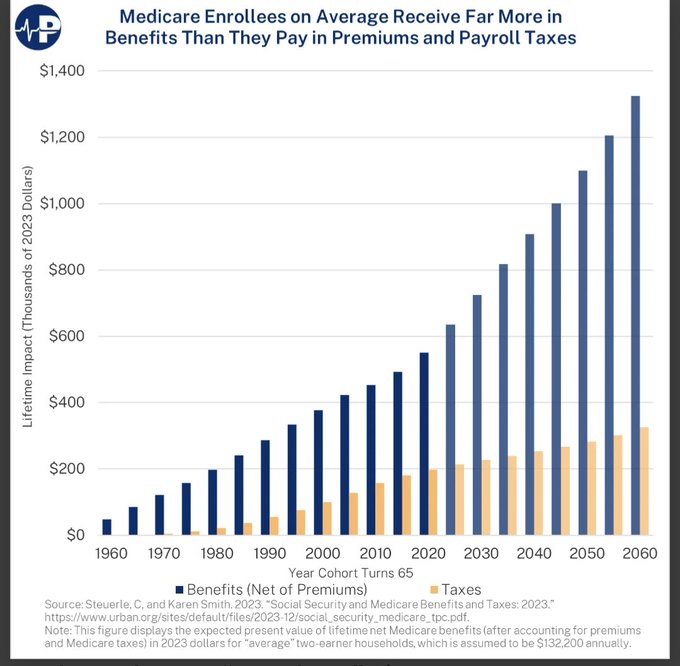
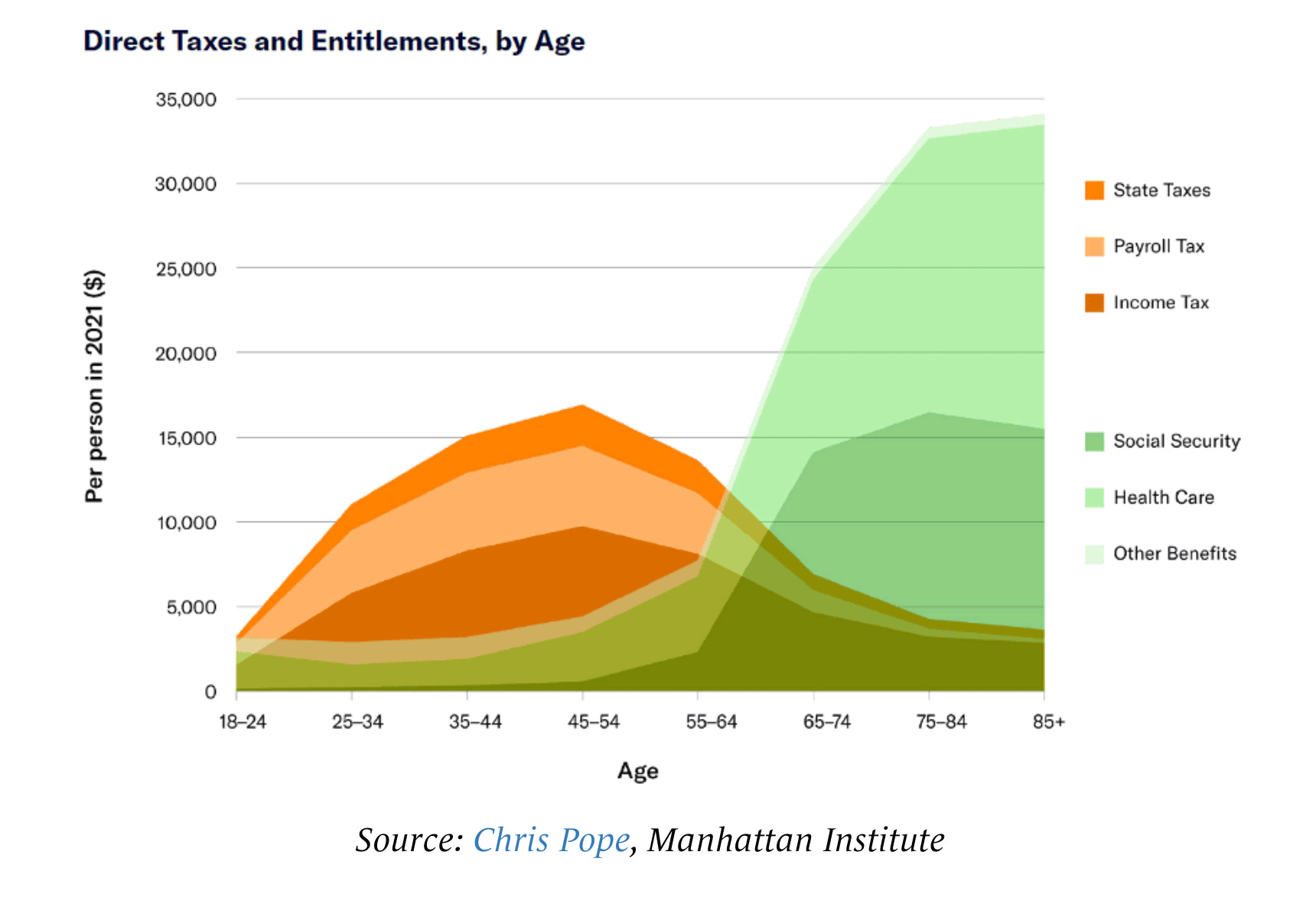
This spending is not cost-effective in terms of quality-adjusted life years per dollar7. (Lest I sound heartless, putting “profits over people”, I note that Eisenhower’s comment on the world in arms is no less applicable to the costs of end-of-life care. In his time, it was defense spending swallowing budgets; now, it is pensions.) About a quarter of this spending is in the last year of a beneficiary’s life. Much of it goes to keeping alive people who are some subset of incontinent, unable to digest conventional food, unable to walk, in constant pain, unable to recognize their relatives, and so neurologically declined as to no longer qualify as sentient. I have no wish to cause needless death, but it is reasonable to question what purpose is being served by extending life in these types of situations.8
This spending is not an investment in the future; it is a giveaway to the past. If you wish to spend your own money to keep yourself or a demented relative alive and in pain, that is your decision; it is neither efficient nor fair to force others to foot the bill through the power of the state. Medicare as it currently exists distorts the choices of seniors and their families around end-of-life care, as the costs are shifted to the taxpayer. This is deeply regressive: by protecting inheritances from being spent on medical care, Medicare hands down unearned wealth between generations, at the expense of those who worked for their money and thus paid high income taxes. While young people struggle to afford to start families, their paychecks are deducted from, and debt is piled on them, to protect the wealth of the old.
As a start, treatment which fails to generate a decent return in quality-adjusted life years per dollar should no longer be funded by Medicare (and replaced with treatments that do more to improve health). This would substantially reduce the budget deficit, also allowing reduction of the net interest payments that are crowding out other spending. Ultimately, the system should be made to pay for itself, with the Medicare tax covering the costs of all care provided. Further, Americans should be free to opt out of both the tax and the coverage, and make deposits in private, protected health savings accounts, or buy private insurance for old age, as they see fit. We should not force those who prefer more consumption today over a few more years of life in a decrepit body to act against their utility function and values.
I realize that, to an older person, this may seem a brutal calculus, one that runs against your interests. But I ask you to consider what kind of world you want to leave your children, your grandchildren, and Americans as a whole. Through human history, and indeed life’s history, parents and grandparents made sacrifices, not uncommonly including their own lives, to give their children and grandchildren a chance to survive and thrive. We the young people of America must ask for that sacrifice now: spend your own money on the health care you need, know when it is your time to go, and leave to us your children the resources we need to build a better future for your grandchildren.
In addition, federal laws obligating hospitals to provide care regardless of prior debts or ability to pay should be repealed. Such cases can and should be handled by state or local programs, or private charitable organizations. This should greatly reduce abuse by drug addicts who overdose repeatedly; vagrants who fake medical issues to get a free warm bed; and other “frequent fliers” who occupy expensive hospital beds, pay nothing, and dump the costs on honest hardworking citizens. (Further, to prevent an exploit arising from this, states should no longer be required to provide medical care to prisoners who will never have the ability to pay for it. If you think it important to save the lives of murderers and rapists, you may contribute to a charity which funds such care.)
However, I support keeping the Medicaid system in place for children. Children are not and cannot be fully independent actors in the economy, and do not choose who their parents are. Allowing children with the potential for full, rich lives ahead of them to die from preventable illnesses would be monstrous, and wasteful to boot: the resources used in raising them would be lost for no return to society from their subsequent presence in the workforce. Unlike Medicare, Medicaid is an investment in the future.
Restore Freedom of Association
I support an absolute prohibition on discrimination based upon ancestry, gender, sexual preferences, religion, and similar fundamental traits by governments (federal, state, and local). It compounds the injustice of taxation to deny to anyone the benefits of payments all are compelled to make due to bigotry. As a member of the Platform Committee for the national Libertarian Party, I voted to restore to our platform the words that “bigotry is irrational and repugnant”, and stand by that statement to the utmost. I consistently stand for equality before the law, and have clashed with far-right infiltrators of my party over these issues.
However, I also believe it is neither necessary nor beneficial to enforce this belief upon private businesses and individuals. Unlike with government, one chooses to interact with such, and can take one’s business to competitors. Once society is out of an equilibrium of widespread discrimination based on bigotry or fallacious prejudices, market competition ensures that opportunity and services will be available to all. Markets, not government, create meritocracy and prosperity.
Immigration: Open to Workers, Closed to Parasites
Because of the strength of American institutions and our first-mover advantages, workers are far more productive in the United States than they are in most countries of origin. This is why illegal immigrants can cover their living expenses from meager wages earned here and still remit funds to their families. Despite the threats of abuse by ICE and employers, they choose to do so by the millions.
There are enormous gains to be obtained by authorizing entry for all potential immigrants willing and able to work or otherwise support themselves in our society without government assistance. Only clearly dangerous individuals such as known criminals/terrorist associates, those previously removed, or contagious-disease carriers would be totally barred from entry. To prevent immigrants from becoming a fiscal drain, they would be totally ineligible for all federal benefits (but remain subject to all taxes). To handle the costs of crime, all male entrants would be required to pay a deposit on the order of tens of thousands of dollars to the federal government (funds currently captured by human smugglers or employers), which would be refunded upon final departure from the United States or becoming a citizen. If an immigrant is convicted of a crime or incurs civil damages, the deposit is deducted from to cover the court-ordered costs, and must be restocked by the depositor for him to remain in the USA. Immigrants would also pay into a fund for compensation of victims who have suffered harm in excess of one deposit from a crime committed by an immigrant.
[Details page to go here]
End the War on Drugs
The time has long since come to admit the reality: drugs have won the War on Drugs. Despite many decades of prohibition, violent enforcement, sting operations, long prison sentences, and civil asset forfeiture, use of illicit drugs has not decreased at all, and overdose deaths have risen dramatically. Today, illegal drugs can be easily sold via text message and the Internet.
First principles of economics show why the government’s approach cannot succeed. It attempts to eliminate the supply of drugs, by blaming the “drug dealers” for the problem, jailing them, and seizing their property. But the cause of the phenomenon is demand: if there is no demand for drugs, there is no supply, because then no one can make a profit selling them. As long as there is demand for drugs, there will be supply, because every supplier eliminated increases the profits available from satisfying that demand.
Hence, the federal government should eliminate all laws restricting what drugs people choose to possess, consume, and transact in. (The only exception is substances which no one would deliberately consume, used primarily to harm others nonconsensually, such as poisons and “date rape” drugs.) By eliminating the unfunded mandate for hospitals to provide lifesaving care to overdose victims unlimited numbers of times, the problem would self-correct: those willing to risk killing themselves with drugs do so, suffering the consequences of their choices. Those who can use drugs responsibly, or at least function in society while using them, would be made free to do so without negotiating with criminals or fearing arrest.
Reform Taxation: Reward Productivity; Tax Rent-Seeking and External Costs
My core approach to taxation is simple: taxes should be applied to unearned, not earned, wealth. Aside from the question of fairness, this encourages productive activity that produces earned wealth, and reduces the rewards from finding ways to extract wealth from others. My overall goals are to reduce the total amount of tax collected (on you, and on your children who will have to pay the ballooning national debt), and change the tax system to allow you to keep more of what you actually earn through your work.
Some of what follows from that principle:
- End special exemptions and privileges in the income tax code, including means of using corporations to reduce tax liability. Where there are genuine positive externalities from something, that should be handled through a separate, explicit subsidy so that it is clear what the costs and benefits are. Every exception to a tax increases the burden of it on everyone else. Every exception eliminated allows reduction of base tax rates.
- Tax real (inflation-adjusted) profits from home sales at a high rate, with associated taxes on profits from raising real rent (with an exception for spare rooms in a primary residence). This would greatly reduce harmful incentives to hoard housing, charge high prices for it, and use local governments to increase artificially its price. It obtains much of the benefits of a Georgist land value tax without forcing people essentially to rent their homes from the government. By deterring speculation, it would lessen wasteful boom-bust cycles in real estate markets by reducing the gains from buying into an appreciating area.9 Houses should be places for families to live, not million-dollar casino chips. This works best combined with cutting the capital gains tax, which would further encourage more productive investments.
- Pollution is aggression. Greenhouse gas emissions which cause harmful climate change are a textbook negative externality. Because both the pollution and the harm are too dispersed for direct transfer of fair compensation, a Pigouvian tax is called for: in this case, often referred to as a “carbon tax”. American fossil fuel companies would be made to pay for their pollution, along with overseas manufacturers (through a border adjustment tax based on the fossil fuel used to make the goods being imported). A large portion of the revenue would be refunded as a flat payment to every adult American citizen (a citizen dividend), to prevent it from being regressive (see here, here, and here for detailed explanations).10 This plan is broadly endorsed by economists. It would fully replace the top-down “green energy” subsidies and climate regulations that it makes redundant. A similar system was put in place to solve the acid rain crisis without heaps of regulations, and it did so extremely well.
- There is no technical reason for modern lawn equipment to be as loud as it is. This has been observed since the 1970s, but very loud mowers have persisted because there has been no incentive to fix it. The noise and fumes from gas mowers and blowers pollute the suburbs and thus defeat their purpose, and cause measurable harm to human health. Mowers which fail to meet automobile noise and emissions standards should be taxed at a high rate, or outright banned, to compensate their external cost. Pollution is aggression.
- All of the above changes would be used to lower base tax rates and to reduce the deficit, which is unsustainably high and putting us on a path to a Greece-like debt crisis. I understand the concept that economic growth means that borrowing effectively transfers consumption from a richer future to a poorer past, so I am more of a deficit sugar glider than a “deficit hawk”, but a major purpose of borrowing rather than taxing is to avoid the deadweight loss from the taxes, which is not working when 14% of federal spending is net interest on debt.
- As it will likely be infeasible to eliminate income tax completely, the child tax credit should be changed from a flat amount for which large tax bills are ineligible, to a percentage of all tax liability (with a minimum, so that low-income households are not made much worse off). As a preliminary figure, each child cared for would reduce one’s income tax owed by 10%, to a maximum of five biological children or two adopted ones11. This is not a giveaway to the rich: it is an investment in the future. Wealthy and upper-middle-class Americans have better genes and better memes than average, or would not have the earnings they do (it is clear that intelligence, conscientiousness, and other traits which boost productivity in society are substantially heritable). By encouraging our most productive citizens to reproduce, we will create more productive citizens in the future who will create value, build a better world, and be a net fiscal benefit.
Right to Bear Arms
I oppose all federal restrictions on the manufacture and possession of weapons, other than weapons of mass destruction. These are solutions in search of a problem. School and similar rampage shootings cause a minuscule fraction of violent deaths of children (let alone deaths of children overall12), but are amplified out of all proportion to the danger by a “if it bleeds, it leads”, media chasing ratings and virality. Total firearm-related deaths are much greater, but that simply demonstrates the reality that it is almost impossible to stop someone determined to possess a gun and use it to harm others from doing so. Societies which have mostly eliminated civilian gun possession (e.g., Britain and New Zealand) had far lower gun ownership rates to begin with, lower baseline levels of violent criminality and fewer dangerous large animals (which increased willingness to surrender guns), and a more naturally compliant population; this would not be possible in the United States even if it were desirable. The best thing the government can do is get out of the way of the right to self-defense (which also reduces the need for taxes for highly salaried law enforcement officials). The right to possess firearms is of no use without the right to use them to protect one’s person and property.
Carrying a gun into a school is not “interstate commerce”, and can and should be handled by local or state governments with a much better appreciation of the context of the act. This should not result in criminal charges or expulsions in rural areas where gun ownership is common and there is no intent to harm anyone.
Private ownership of fully automatic weapons including heavy machine guns has been legal for decades, and more than 600,000 such guns are registered, but such guns have never once been used in a mass-casualty incident in the United States. This is why the ban on selling newly manufactured versions of such weapons to civilians should be eliminated. Citizens in rural areas who can be easily outnumbered by a carful of criminals (or a group of aggressive feral hogs) and are far from law enforcement or other help should be allowed machine guns to protect themselves. (Machine gun owners are also more useful in the unorganized militia, such as for decentralized national defense, if such needs arise.)
However, I am also opposed to mandating universal concealed carry reciprocity, as I consider it inconsistent with federalism. If the people of Hawaii or Massachusetts wish to limit the carrying of items which are, we should not forget, dangerous by design, there is no good cause for DC to interfere. Those who want to carry handguns are free to move to other states which allow this (as Ohio does).
Accountability for the President
While I agree with some of the Republican agenda, President Trump has engaged in an unprecedented pattern of abuses of power and blatant corruption which cannot be allowed to stand as acceptable. Restoring prosperity and security in Ohio need not mean tolerating these things.
A long rant about the specific issues would be superfluous and redundant. This section mostly lacks links, as none should be needed. Yet I do feel the need to elaborate on some which I most object to:
- Trump chose to claim there was electoral fraud on a sufficient scale to change the outcome of the 2020 election despite the absence of any credible evidence for this. On this basis, he incited a riot, during which his armed supporters forced their way into the Capitol, severely injured police officers, and attempted to harm the Vice President and duly elected members of Congress. He declined to order in military forces to secure the building, forcing the dubiously constitutional maneuver of Mike Pence doing so.
- Without any authorization from Congress, he has vandalized and desecrated national monuments, tearing down a full third of the iconic shape of the White House, demanding his own name be carved into the Kennedy Center, and damaging the Reflecting Pool’s coating with his vehicles and then attempting to frame someone for it.
- The TRUMP memecoin was used to dupe his supporters and others: it lost more than 95% of its value, while Trump’s family made hundreds of millions (partly by offering a special meeting with Trump and tour of the White House to the largest holders). Many buyers were foreigners and/or those seeking influence, specific policy changes, or pardons. World Liberty Financial, partially owned by Trump’s family members, operates on the same principle: selling a range of cryptocurrencies to foreign governments and pardon seekers. This is industrial-scale bribery.
- Despite the President’s rhetoric about fraud, prosecutions for fraud in federal programs and procurement are three times more likely to be declined than before 2025.
- Trump has persistently funneled taxpayer money to his family’s businesses, and those he owns shares in. Requiring the Secret Service to sleep in Trump’s hotels is a well-known and persistent example; security for Trump’s personal trips has cost taxpayers over $100,000,000, much of that flowing to him. Further examples abound: holding the 2026 G20 summit in a Trump hotel, investments in private prisons used for ICE detention, Dell’s contracts with the Pentagon two months after Trump bought millions of dollars of shares, and similar deals involving Boeing and Vulcan Elements.
If elected, I would vote to hold the President accountable for his actions.
Artificial Intelligence
There is minimal discussion of artificial intelligence advances in the rest of this platform, because the rest of it is based on the implicit assumption that how world-transforming AI will be is at the low end of the plausible range. In scenarios with very powerful AI, most of these policy debates become moot, and it is impossible to effectively prepare.
However, I share concerns about AI safety, to a degree almost inconsistent with my party’s ideology. It should go without saying that Skynet killing us all would cause harm far beyond anyone’s ability to pay compensation, so the insurance mechanism proposed in an earlier section cannot be applicable. I support strong federal regulation, including negotiations with China as necessary, to ensure that any potential artificial superintelligence is verifiably transparent, corrigible, and aligned with human interests.
Permanent Standard Time, Not A Permanent Lie
I support ending the institution of Daylight Savings Time, replacing the twice-yearly clock change with permanent standard time.
The time zones were crafted around the goal of a reasonable approximation of local solar noon. Noon is when the sun is highest and most southerly in the sky. That is what the clock means: “a.m.” and “p.m.” stand for ante meridian and post meridian: before and after the sun has crossed the meridian (north-south) line. In a time of ever-increasing disconnection from the natural world due to overuse of air conditioning, addictive devices with screens, and the irrational fear of child abductors, we should not be further severing the rhythm of our lives from that of the Earth’s spin and Sol’s apparent jaunt across the sky. Why can’t businesses change their own work and business hours as seasonally appropriate?
Footnotes
- In Ohio, it is mostly Democrats who complain about this because the Republicans have the majority and thus can do it to their advantage. But in other states, this is very much reversed. The goal here is to solve the problem nationwide, so Ohio Republicans don’t have to race to the bottom against Illinois Democrats. ↩︎
- Note that the linked prices are nominal. The price of clothing has barely increased nominally in the last 25 years; the wage-hours required to clothe oneself are less than a quarter of what they were. ↩︎
- Going even further: as a “nuclear option” to lower housing costs, the federal government could buy unused land in high-demand areas, thus exempting it from state land-use regulations, and allow private developers to build high-density housing on it, to be auctioned to private owners after construction is complete. ↩︎
- These are often referred to as “public schools”. ↩︎
- This department has not been renamed by act of Congress as legally required, and thus is not the “Department of War”. ↩︎
- In every post-9/11 incident listed, passengers aware of the danger stopped the would-be attacker. This, combined with hardening of cockpit doors, by themselves made another 9/11-style attack impossible, but the paranoia continued. In fact, the security measures cause hundreds of additional deaths each year because they push marginal trips from being made by plane to being made by driving, which is much more dangerous. ↩︎
- In fact, as noted in the final link of this sentence, there is a strong case to be made that it has no measurable positive effect at all! ↩︎
- There is in fact a strong case that a much better expected return on investment would be for the government to pay for cryonic freezing of elderly Americans before cognitive decline becomes severe. This would, in principle, allow them to be revived or uploaded when future technology allows, resulting in thousands of additional experienced high-quality life years per person or even functional immortality. ↩︎
- and, thus, the opportunity cost of buying into a depreciating area ↩︎
- “Regressive” means that it takes a higher proportion of a lower income. This would happen because rich people invest some of their earnings while poorer families have to spend what they make. The dividend, as a flat payment, prevents this: the rich and poor get the same amount, so the rich end up paying more because they consume more. Flying a private jet causes much more emissions per person than flying coach or not at all, so a private jet user ends up paying more carbon tax, and so on. ↩︎
- The limits are necessary to prevent abuses contrary to the purpose of the policy. The infertile can still benefit from the two-adoptee policy, which will also lead to fewer kids bouncing around foster care systems and more in stable, caring homes. ↩︎
- See Table 7 in source, category 5-14. ↩︎